tay rivers trust priority projects
The Tay Rivers Trust has identified 10 projects from the wider River Plan which it wishes to champion.
Three of these, the Lowland Rivers Project, the Upper Shee Project and the River Lyon Chemistry Project have been identified as top priorities for the Trust. In addition, we are working with partners on projects on the Eden and the Ericht.
1. Lowland Rivers Project
Significant stretches of a number of tributaries are unfenced, with livestock grazing right up to the water’s edge. This is particularly an issue on the lower Isla downstream of the Dean confluence, the Earn and some more upland tributaries such as the Dochart. In these lower gradient meandering rivers with finer substrates, grazing accelerates bank erosion, leading to sediment inputs and over-widened channels lacking in marginal cover.
The aim of this project is to achieve stock exclusion along these reaches by means of fencing or otherwise.
This is an ambitious project which will require considerable farmer engagement / persuasion and funding to be found for works.
2. Ameliorating increasing headwater temperatures (UPPER shee project)
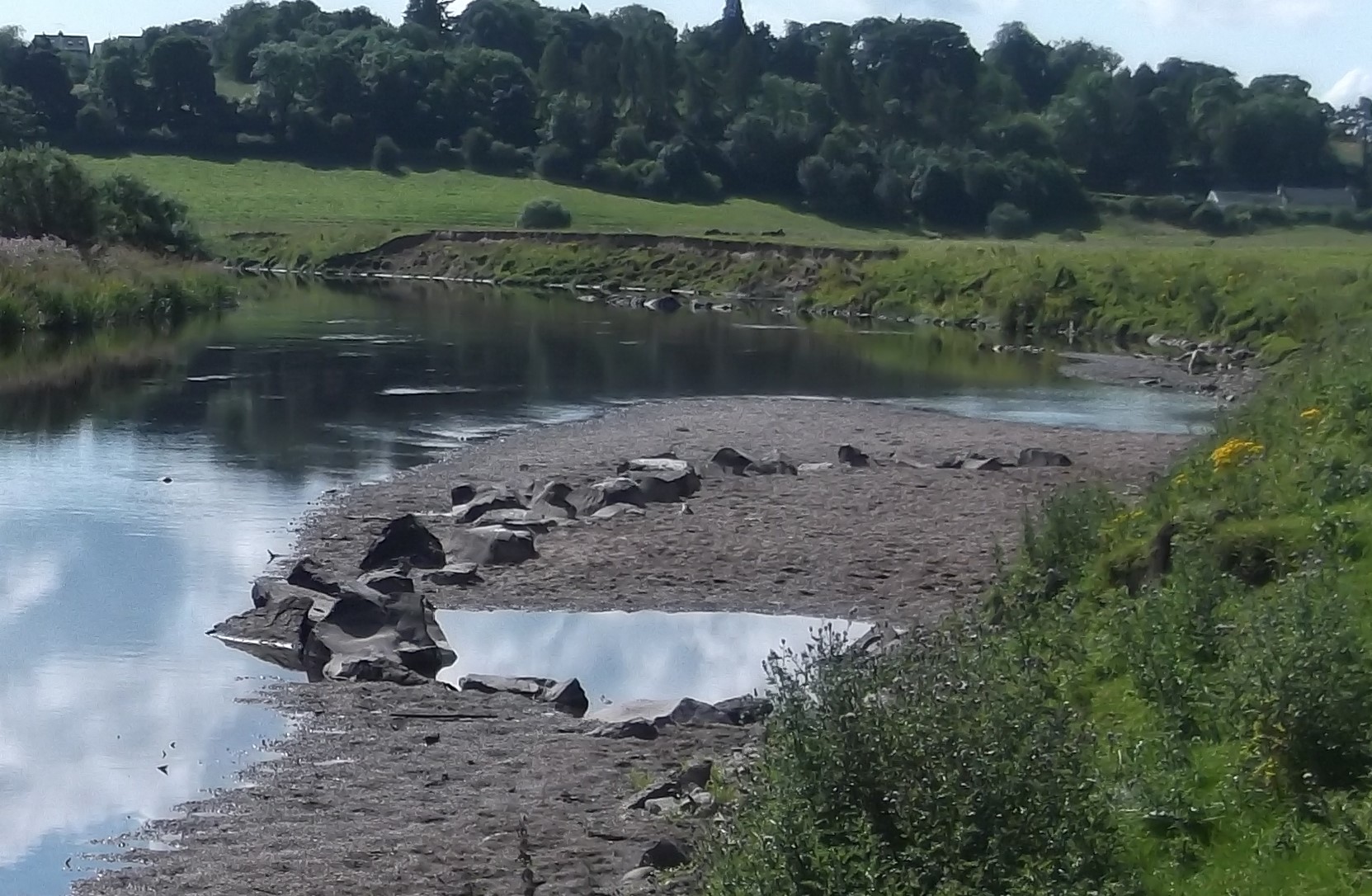
There is increasing concern that, with increasing peak summer temperatures, some rivers, even in Scotland, will become too hot for juvenile salmon. The most vulnerable rivers are shallow open rivers with protruding stones which absorb heat, such as are typically found in upland areas. The best means of preventing this on vulnerable rivers is to plant trees to create future shading. This is seen as a significant issue within the Scottish Wild Salmon Strategy.
We have identified several steps in this process. Firstly, there is a need to determine which Tay tributaries are most at risk as, not all will be, given the reach of hydro and existing levels of shading in many tributaries. Then we wish to work with landowners and other stakeholders to develop fencing / tree planting projects, where appropriate and possible.
An opportunity has arisen to commence this process on the River Shee and tributaries. This area is open and vulnerable to heating, as well as being the most productive spring salmon nursery area in the whole Tay catchment.
The project is to start by collecting data on water temperatures in the various tributaries of the River Shee to identify those most at risk from heating and any that are more resilient, for example, those which benefit from significant groundwater inflows. This will be done though the installation of a network of temperature loggers. Once vulnerable areas are identified we will work with landowners to design appropriate and acceptable planting projects and seek funding for.
Based on the success of work in Glen Shee we would hope in time to expand this work to other open upland tributaries of the Tay and Earn.

3. the effect of signal crayfish
Invasive signal crayfish are present in several parts of the Tay district but, while seemingly not that apparent in some areas such as the River Earn, where they are present, they have been spreading rapidly and very noticeably in the Ericht system since first identified in a localised area in 2006.
The effect of signal crayfish on salmon and other ecology in our rivers is not clear and still subject to some speculation. This colonisation event offers a one-off monitoring opportunity if baseline data on salmon can be collected before watercourses of a size that can be monitored are overrun. In fact, it is likely that the best potential monitoring sites have already been overrun.
In order to capture what opportunity still remains, it is imperative to first identify where crayfish have spread to and to do so quickly. We must establish the limits of the population in the Ericht system.
The usual method, trapping, is likely to be a very inefficient way of doing this. Environmental DNA (eDNA) offers a potentially easy solution certainly for identifying upstream limits. The potential to use this technique is being actively explored with the University of the Highlands and Islands.

4. Non native fish in the Rannoch area
A number of species of coarse fish were introduced to several smaller lochs and lochans in the west Rannoch area several decades ago. These present a threat, should they ever escape or be moved, to both the unique genotypes of charr and trout present in lochs Laidon and Rannoch and to the further Tummel and Tay system. Climate change will increase this risk as cyprinid fish do better in warmer temperatures.
We are working with local stakeholders to develop a project to ensure these populations pose no future risk.
5. Smolt tagging, River Tummel
A significant investment has already been made by both the Tay Rivers Trust and TDSFB PIT tagging smolts in the River Tummel catchment. However, we have concerns that the apparent return rates may not be representative of nature. The River Tummel could not produce the numbers of adult salmon observed going through SSE’s Pitlochry fish counter in recent years if marine survival rates really were of the order of 2%. One possibility is that extra mortality occurs either directly or indirectly as a result of PIT tagging.
This issue needs to be cleared up before we proceed further.
The Errochty Water, where much of the PIT tagging took place, potentially offers as good an opportunity for testing this. It is proposed that a PIT tag detector is obtained and installed in the lower Errochty. This would detect migrant smolts (or parr) PIT tagged upstream as large parr in the summer and autumn previous. As it is hoped such fish will have fully recovered from any adverse effects of PIT tagging before they migrate, they should form a control against other smolts which are caught and tagged in spring in the usual way. The subsequent performance of these smolts would be ascertained when they trigger a detector in the Pitlochry Dam fish pass on their return adult migration.
6. Long term trends in invertebrate abundance
We are frequently asked whether invertebrate populations may have declined on the River Tay and its tributaries. The only existing long term datasets which might prove this or otherwise, at least for recent decades, are held by SEPA. However, we understand these have never been collated for such a purpose.
Several years ago, Buglife performed exactly such an analysis for the River Spey and have indicated they would be willing to do the same for a selected range of sites from the Tay catchment. However, development of this proposal was put on temporary hold, hopefully temporary, because SEPA’s datasets were not available following the SEPA cyberattack. We are now hopeful that progress will now be made in due course.
7. River Lyon chemistry
Previous work has shown the River Lyon’s invertebrate community differs from expected and the growth rate of juvenile salmon is among the lowest in the Tay district. Poor growth conditions appear to be a major controlling factor of the upper Lyon salmon population.
It is suspected that this may be a result of the fact that the River Lyon is maintained by a “compensation” flow from turbines at the base of reservoirs rather than from the surface. This gives the compensation flow an unnatural annual thermal regime and a very limited spot sampling showed the main river chemistry differed from that of burns flowing into the Loch Lyon reservoir.
While it might not be very practical to change temperature, water chemistry might be much more amenable to improvement. However, before a case for that is made, this project seeks to more fully understand how much the chemistry differs over the course of the year. This will require identifying chemical change during the different seasons and under different levels of natural runoff.
8. Gene banking
The River Tay catchment is home to a diverse range of salmon sub-stocks, some of which, like the famous Loch Tay large “springers” represent a scarce type in Scotland. Were these sub populations to be wiped out by a temporary event, such as the introduction of the Gyrodactylus parasite, these unique traits would be lost forever.
In Norway, gene banks have been set up to preserve salmon genotypes for exactly this purpose, so that populations could be restored after unforeseen collapse. A recent paper summarises the situation. This includes both captive populations which presumably work like our kelt reconditioning and cryopreservation of milt. The paper indicates the latter would appear to work quite well.
We wish to investigate the feasibility of establishing such a system for the River Tay.
9. Juvenile fish populations in medium sized rivers
Surprisingly little is known about the populations of juvenile salmon and other fish that live in medium and larger rivers that are too deep to be electrofished. This is a serious omission, given much of the Tay’s fish resource is produced in such rivers, which amount to much of the catchment’s surface area of flowing water.
These larger rivers form a big part of Marine Scotland’s annual stock assessment exercise. But limited information means these assessments are based on assumptions derived from wholly different types of rivers. This is particularly true of the relatively low gradient Earn.
In very large, swift or bouldery rivers, all forms of assessment may be very difficult, ruling out the Tay, but in medium sized rivers with a low enough gradient, it is proposed to assess larger juveniles (i.e. bigger than fry) using a fish meshed seine (sweep) net. This method would likely be particularly applicable to the Earn and the lower Isla.
10. Salmon in the classroom
Salmon in the Classroom is a popular project with schools but locally has been very limited in scale. We hope to increase the resource and increase the number of schools that might be able to participate.