Catch & release best practice
ENSURING RELEASED FISH SURVIVE
The purpose of releasing salmon is to ensure that they survive to spawn. They will not do this if they sustain injury or damage which allows fungus to attack. The fungus Saprolegnia, is an ever present menance and can quickly overcome fish which are stressed or damaged. The mucus is the first line of defence and should not be damaged. The following simple steps must be followed:
Landing the fish:
- Use a fine, knotless meshed landing net and ensure the fish remains in the water.
- Do not beach the fish, as abrasion can lead to infection. Knotted nets, gaffs and tailers are now illegal in Scotland anyway.
- Minimise handling the fish. Fish should never be “tailed”.
Removing the hook:
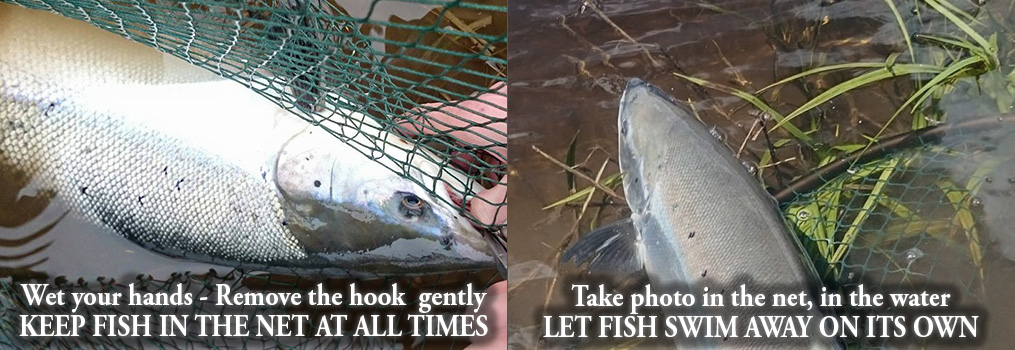
- Wet your hands. A dry, bare, warm hand can cause abrasion which later may lead to infection.
- Remove the hook gently. If possible remove the hook using forceps or a hook disgorger, taking care not to squeeze the fish.
- The use of barbless or micro barbed single hooks is strongly recommended, as they make removing the hook easier.
- Take care with fresh, early fish as they are prone to damage and fungal infection.
Returning the fish:
- If possible, try to slip the fish out of the net without touching it!
- If you really must, then support the fish, in a current, facing upstream and allow time for the fish to recover and swim away on its own.
- Do not weigh the fish but estimate the weight of the fish from its length. Record all fish caught and released.
Photographs by all means, but do not remove the fish from the net which should remain in the water. However tempting, PLEASE DON’T GRASP A FISH’S TAIL!! This can result in fungal infection.
The web is strewn with photos of salmon held like this. If you are to release fish, especially fresh run salmon, this is a recipie for trouble. The abrasion caused by fingers provides an inroad for fungus, especially around the tail. DONT DO IT!
REMOVE HOOKS FROM RAPALAS
Rapala and other multiple hook lures are popular on some beats on the Tay and in Loch Tay. As the number of treble hooks attached can lead to problems in hook removal it is recommended that such lures must be used with a maximum of one treble hook only.