Tay Rivers Trust Fundraising 2022/23
Some of the projects proposed in the Management Plan produced by the Tay District Salmon Fisheries Board for 2022 to 2024 on the Tay, Earn and Eden are beyond the resources currently available.
The Tay Rivers Trust are aiming to raise funds through fundraising to add to those resources obtained through the Tay proprietors annual levy.
The board and trust itself cannot do much to influence what happens at sea, where salmon do have problems currently, therefore, we must do all we can to help the salmon when they are in our care in our rivers. Therefore, the overriding objective for the river to export as many smolts as possible to sustain and hopefully in time rebuild catches and ensure the Tay remains one of the most productive salmon rivers in Scotland.
Please support us and help save wild Atlantic salmon
Calum Innes,
Chairman, Tay Rivers Trust
Fundraising 2022/23
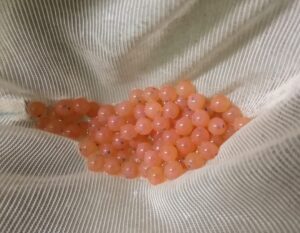
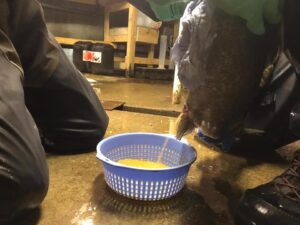
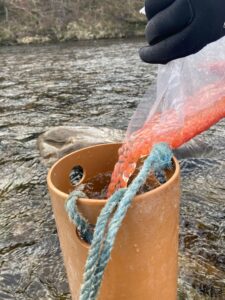
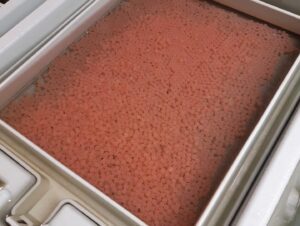
Smolts & Juvenile Productivity – Boosting egg and juvenile production in the Summerhill Hatchery and improving survival rates of juveniles in the Tay Catchment. Kelt reconditioning at the Summerhill Hatchery is a ground breaking project, unique in the UK and the largest initiative in the Tay catchment. One million spring salmon eggs have been produced each year which has allowed stocking in areas where the salmon population requires restoration.
Summerhill Hatchery, Gene Bank – Living gene and frozen gene bank to preserve Atlantic salmon genotypes in case of requirement to restore populations after collapse e.g. Gyrodactylus. This includes both captive populations with our kelt reconditioning and potentially cryopreservation of milt. This is of value to the Tay and nationally.
Smolt Tagging – to get a better understanding of the return from smolts – There are concerns that the apparent return rates of PIT tagged salmon to the River Tummel may not be representative of nature. The River Tummel could not produce the numbers of adult salmon observed going through the fish counter if marine survival rates really are only of the order of 2%. One possibility is that extra mortality occurs either directly or indirectly as a result of PIT tagging. This issue needs to be cleared up before we proceed further.
If a PIT tag detector could be installed in the lower Errochty Water, migrant smolts that were tagged upstream as parr would form a control against other smolts trapped and tagged in spring in the usual way. The first trial requires a minimum 1,000 parr to be tagged.
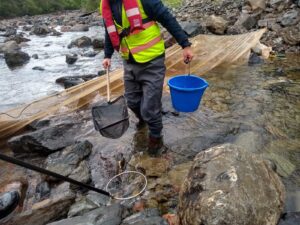
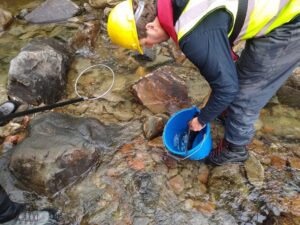
Juvenile Fish Populations – Little is known about the populations of juvenile salmon and other fish that live in rivers that are too deep to be electrofished. We wish to assess juvenile populations using a fine meshed sweep net to provide an index of fish abundance (salmon, grayling and trout being main species expected) from year to year. This method would be applicable to the Earn and the lower Isla.
River Lyon – The growth rate of juvenile salmon is among the lowest in the Tay district and poor growth conditions appear to be a major controlling factor of the upper Lyon salmon population. The river is maintained by a “compensation” flow from the base of reservoirs which gives it an unnatural temperature regime and limited sampling showed the main river’s chemistry can differ from that of burns flowing into the Loch Lyon reservoir.
While it might not be practical to change temperature, water chemistry might be more amenable to improvement. This project seeks to identify chemical change throughout the seasons and under different levels of natural runoff with, initially, the installation of automatic continuous loggers to record pH and electrical conductivity.
HABITAT
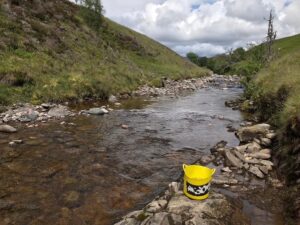
Headwater Temperaturs – There is a need to determine which Tay tributaries are most at risk of overheating with warmer summers, which may then become priorities for tree planting to increase shade. Potential at-risk areas could be the Ruchill (Earn), Almond,Cononish/Dochart, Lochay, Ba, Tilt, upper Ardle and upper Shee. The initial need is to install temperature loggers to firstly confirm or refine this priority list. These loggers only cost a little over £140 pounds each and we are looking to install a network of these initially.
River Bank Fencing Project –Significant stretches of a number of rivers in the catchment are unfenced, with livestock grazing right up to the water’s edge. This is particularly an issue on the lower Isla downstream of the Dean confluence, the Earn and some more upland tributaries such as the Dochart. In such lower gradient meandering rivers with finer substrates, grazing results in eroding banks, over-widened channels lacking in marginal cover and sediment inputs.
The aim of this project is to achieve stock exclusion along these reaches by means of fencing or otherwise. This is an ambitious project which will require considerable farmer engagement / persuasion and funding to be found for works.
Reconnecting the Fillan Water with its FloodPlain – The Fillan Water is an important spawning area for Loch Tay spring salmon and this project should improve conditions for them. A high floodbank keeps spate water within the river’s channel meaning that there is increased energy at the point where the floodbank ends. Thereafter, the river is very unstable and banks are severely eroded. Fewer adult salmon spawn in this area as a consequence. By lowering the bank, the power of floods will be reduced in the main channel and, in time, the channel below should become less unstable.
Clearing Blockages and Beaver Dams – In order to maximise the production of juvenile salmonids, and numbers of returning adults, it is essential to ensure that spawning adults are as widely distributed as possible throughout the Tay and its tributaries. In this regard it is necessary that salmon and trout have easy access into and through spawning tributaries and burns.
This issue has become much more acute in recent years with the spread of beavers locally. Beaver dams appear regularly in parts of the catchment. Some are of a size to block significant spawning burns in the autumn and could block the passage of smolts in dry springs. Searching for dams and managing them where necessary is an increasingly time-consuming task.
Weirs – There are two large weirs on the Shochie Burn near Luncarty, four miles north of Perth. Both have fish passes and good numbers of juveniles are found upstream, indicating these passes work as well as fish passes do.
However, in both cases, continued maintenance is required to make sure the passes are clear and not deteriorating due to age. Beavers now complicate matters by using these sites for damming. Therefore, we would ultimately like to see these weirs removed or substantially modified.
Invasive Species
Signal Crayfish – are present in several parts of the district, but, while not so apparent in some areas such as the Earn, they have been spreading rapidly in the Ericht system. It is feared they will have an impact on juvenile salmon but this risk is still poorly understood. In order to capture what opportunity still remains to obtain baseline data on the salmon population before it is completely overrun, it is imperative to identify where crayfish have spread to and to do so quickly.
Environmental DNA (eDNA) offers a potentially easy solution for identifying upstream limits and possibly indicating where numbers are thinning out at the downstream end. Fish surveys will then follow.
Non Native Fish In The Rannoch Area – A number of species of coarse fish were introduced to several smaller lochs and lochans in the west Rannoch area some decades ago. Should they ever escape or be moved, to both the unique genotypes of char and trout present in lochs Laidon and Rannoch and to the further Tummel and Tay system. Climate change will increase this risk as cyprinid fish do better in warmer temperatures.
We wish to see this threat managed or hopefully eliminated altogether.
EDUCATION
The next generation of Tay conservationists – Educating the next generation about rivers, their inhabitants and the environment is seen as a vital task. A key part of both programmes is bringing fish directly into the primary classroom. From the Summerhill Hatchery we provide eyed salmon eggs to each school. These are placed in fish tanks held in chiller cabinets. This enables the children to watch daily the hatching of the eggs and development of the baby fish, which are then returned to a local river. Fish are not the only topics covered during such field trips. Kick samples of aquatic life are taken and the youngsters are invited to count and identify them using simple keys.
Salmon in the Classroom is a popular project but has been constrained by having people to deliver the project and the cost of bus hire.
TAY RIVERS TRUST
The Tay Rivers Trust was set up in 1987, then called the Tay Foundation. Since that time it has been, and continues to be, involved in numerous projects aimed at safeguarding and improving the health of the River Tay system.
The main early project the Tay Foundation was responsible for, and to this day its most significant project, was raising funds for the buyout of net fisheries in the Tay estuary owned by Perth and Kinross Council and the Tay Salmon Fisheries Company. This process was finally completed at the end of the 1996 netting season. The Tay Rivers Trust now has a long lease of all the major net fisheries in the Firth of Tay and indeed is outright owner of another which was gifted to it.
Thereafter the Tay Rivers Trust has continued to fund research projects within the district and contribute to various conservation initiatives, for example the buyout of the Northumbrian Drift net fishery in 2003.
Detailed descriptions of the projects the Tay Rivers Trust has been involved in or contributed to can be found here.
Share your news and photographs on our Facebook, Instagram and Twitter pages