Tay Rivers Trust Fundraising 2022/23 – Habitat restoration
The life cycle of salmon gives it the status of a ‘Barometer’ species, proiding detailed information about our environment. We need to do everything we can to help Atlantic salmon when they are in our care in out rivers.
The Tay Rivers Trust are aiming to raise funds through fundraising to add to those resources obtained through the Tay proprietors annual levy.
Please support us and help save wild Atlantic salmon
Calum Innes,
Chairman, Tay Rivers Trust

Habitat Restoration
Headwater Temperatures
There is a need to determine which Tay tributaries are most at risk of overheating with warmer summers, which may then become priorities for tree planting to increase shade. Potential at-risk areas could be the Ruchill (Earn), Almond,Cononish/Dochart, Lochay, Ba, Tilt, upper Ardle and upper Shee. The initial need is to install temperature loggers to firstly confirm or refine this priority list. We are looking to install a network of temperatures loggers initially. Each logger costs £250 to install.

River Bank Fencing Project
Significant stretches of a number of rivers in the catchment are unfenced, with livestock grazing right up to the water’s edge. This is particularly an issue on the lower Isla downstream of the Dean confluence, the Earn and some more upland tributaries such as the Dochart. In such lower gradient meandering rivers with finer substrates, grazing results in eroding banks, over-widened channels lacking in marginal cover and sediment inputs.
The aim of this project is to achieve stock exclusion along these reaches by means of fencing or otherwise. This is an ambitious project which will require considerable farmer engagement / persuasion and funding to be found for works.
Reconnecting the Fillan Water with its FloodPlain
The Fillan Water is an important spawning area for Loch Tay spring salmon and this project should improve conditions for them. A high floodbank keeps spate water within the river’s channel meaning that there is increased energy at the point where the floodbank ends. Thereafter, the river is very unstable and banks are severely eroded. Fewer adult salmon spawn in this area as a consequence. By lowering the bank, the power of floods will be reduced in the main channel and, in time, the channel below should become less unstable.
 Clearing Blockages and Beaver Dams
In order to maximise the production of juvenile salmonids, and numbers of returning adults, it is essential to ensure that spawning adults are as widely distributed as possible throughout the Tay and its tributaries. In this regard it is necessary that salmon and trout have easy access into and through spawning tributaries and burns.
This issue has become much more acute in recent years with the spread of beavers locally. Beaver dams appear regularly in parts of the catchment. Some are of a size to block significant spawning burns in the autumn and could block the passage of smolts in dry springs. Searching for dams and managing them where necessary is an increasingly time-consuming task.
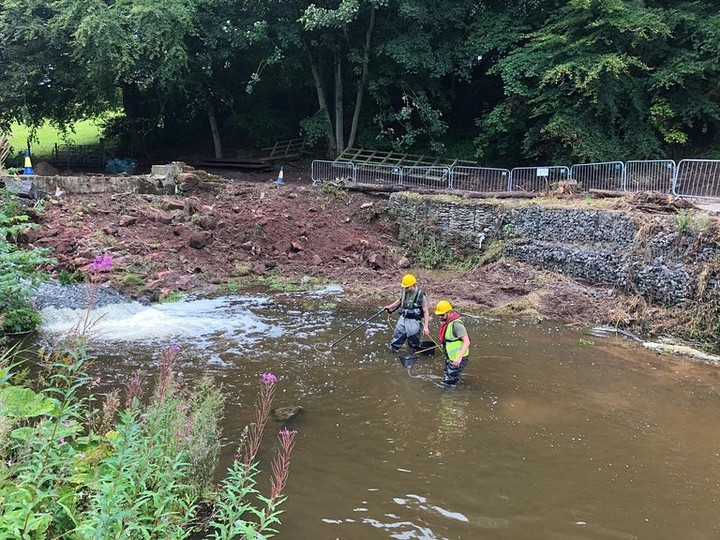
Weirs
There are two large weirs on the Shochie Burn near Luncarty, four miles north of Perth. Both have fish passes and good numbers of juveniles are found upstream, indicating these passes work as well as fish passes do.
However, in both cases, continued maintenance is required to make sure the passes are clear and not deteriorating due to age. Beavers now complicate matters by using these sites for damming. Therefore, we would ultimately like to see these weirs removed or substantially modified.
If you wish to discuss making a significant gift to make a strategic impact to atlantic salmon in the Tay river catchment please contact our Major Gifts Fundraiser, here.
TAY RIVERS TRUST 2022/23 Fundraising
- Smolts & Juvenile Population
- Habitat Restoration
- Invasive Species
- Salmon in the Classroom