ARE TAY SALMON GETTING BIGGER?
Since the start of the season a few weeks ago, there have not been that many spring salmon caught yet, but, of those that have, the quality has been excellent. The average weight is well up in the teens of pounds. There has even been a 30 pounder and smaller fish in the 7 to 9 pound class have been notable by their absence.
But this continues to fit with a pattern we have seen developing for a number of years. The average size of returning Tay salmon seems to be getting bigger!
Understandably, such claims have been met with some scepticism, but what do the data actually say?
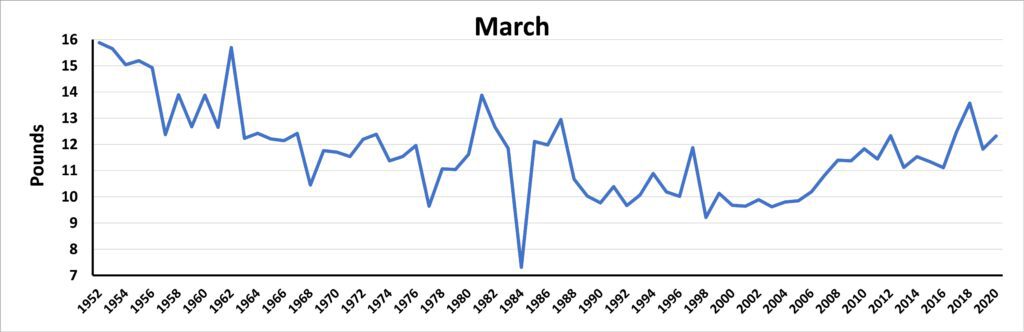
Well, below, we consider average weights of “salmon” (that is all salmon including grilse) caught by anglers in the Tay district per month as reported to Marine Scotland since 1952.
It is quite clear that, not only for January, but February and March too, average weights have been rising for the last 15 years, from a low point following a long period of decline.
The cause of this change is not because the fish are growing faster, but rather because a larger proportion seem to be remaining at sea to mature as 3 sea winter fish. 3SW fish tend to return earliest in the year, peaking in March.


By April, the increase is still there, but less steep and the average weight lower than earlier. This is because 2SW fish now make up a greater proportion of the catch.

For May, however, there hasn’t been any increase. May is still flatlining because the catch now is overwhelmingly 2SW fish and perhaps because they are smaller for their age than they once were.

In June, the average weight is even less, perhaps because grilse are starting to figure, but again, there is a hint of a recent increase.

By July, grilse traditionally make up much of the catch. This is reflected in the lower average weight overall. However, again, weights are trending upwards in recent years.

In August, weights recently appear slightly up on years around 2000, but it’s not a marked upward trend. September isn’t much more than flatlining at the lowest level.


October, on the other hand, does also show a bit of upward trend.

So, how should these differences be explained?
The early months and July are months when the catch is particularly comprised of mixed sea age fish (2SW and 3SW early on and 1SW and 2SW in July) which, crucially, are mainly fresh run. The increased weight in these months has resulted from a shift towards more older sea age fish. September appears not to have changed, but these data hide significant things happening. For example, from the 1980s until even after 2010, large autumn grilse were a dominant part of the catch, although their average size declined. But, in recent years, that class of fresh autumn grilse has “disappeared” and the catch is now almost completely composed of coloured or colouring fish which entered earlier in the season. The coloured grilse being caught are much smaller than the ca. 8 pound fresh grilse once common. They are offsetting the larger coloured MSW fish also present. August probably is influenced by similar, but by October, the small coloured grilse no longer figure so much and the average weight is increasing again.
Taking all this is the round, bearing in mind September is a big month in terms of catch, the annual average hasn’t increased that much, but it has been increasing, even leaving out 2006, a year when there were a lot of small grilse in late summer.
Tay salmon are getting bigger again!
